Translate Us iPhone Translation Checks
Can Translating Back Check a Translation on iPhone?
Short answer: Translating back can flag a meaning change. Preserve the original, translate the exact target wording back, and compare actions, negation and details. A match does not certify the target.
Use a three-part back-translation record to spot changed meaning, preserve the actual target text and know when a matching return still needs review.

Published by Clara Publisher
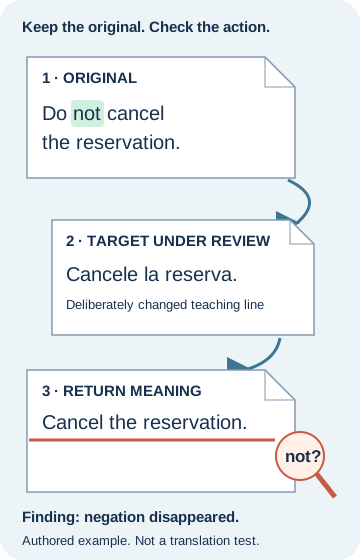
A back translation is a second translation from the target language into your original language. It can reveal a discrepancy worth checking, but it cannot certify that the target is accurate, natural or appropriate. A change could arise in the first translation, the return translation, or both.
Keep three separate texts: your original, the exact target wording you received, and its return translation. Compare meaning rather than matching every word. The completed example below shows a missing negative instruction without pretending that an app produced it.
Spanish → English · Illustrative workflow
Return the exact target wording
Deliberately authored discrepancy example. These are not captured app results or a measured translation test.
-
Actual target in the teaching record
Spanish input
Cancele la reserva.
-
Its English meaning
English translation
Cancel the reservation.
-
Compare with the preserved original
The original says Do not cancel the reservation. Negation is missing: hold the message and check the target wording.
A completed example: a missing do not
This is a deliberately constructed teaching record. The Spanish target has been written with a changed instruction so you can see what the comparison detects. It is not a test result from Translate Us or any other engine.
The original asks someone to keep the reservation. The Spanish line Cancele la reserva means cancel the reservation; the returned English therefore reveals the opposite action. The useful finding is missing negation, not a percentage accuracy score.
Example
- Preserved original
- Do not cancel the reservation.
- Target wording under review
- Cancele la reserva.
- Return meaning
- Cancel the reservation.
- Completed comparison
- The action is reversed: do not is missing. Do not send this target wording.
- Next verification
- Ask a reader of Spanish whether the target explicitly says not to cancel; check that exact line before using it.
Make your own three-part record
On an iPhone, keep the record in a note or other place where you can compare the texts. Preserve line breaks, numbers and the full relevant sentence. Do not reconstruct the target from memory or silently tidy it before checking.
For the return step, the language of the target wording becomes the source language and your original language becomes the destination. This describes the language direction, not a particular button or app screen.
- Save the original sentence before translating it.
- Save the exact target output separately, including any names, amounts and conditions.
- Translate that target text back into the original language using a translator that supports the required direction.
- Keep the return beside the first two texts; mark each changed action, person, negative, condition, number or date.
- Use a discrepancy to ask a specific question of someone who reads the target. Leave it unresolved until you have that evidence.
Compare the parts that change the message
Ask who is acting, what they are doing, and to whom. Then compare whether the instruction is positive or negative, conditional or unconditional, and whether a time is a deadline or an appointment.
Wording can change without changing the request. Could you send the address? and Please send the address may express a similar practical request while differing in tone. A return translation can draw attention to that difference; it does not tell you automatically which target wording suits your relationship.
- Actor and recipient: did I become you, or did a named person disappear?
- Action and negation: did keep become cancel, or did not disappear?
- Conditions: did only if become always?
- Details: are time, amount, currency and unit still attached to the right thing?
What a close match leaves uncertain
Two translation steps can agree while missing a problem in the target. A return that resembles the original is a useful observation, not a certificate of naturalness, politeness or suitability. Repeating the same system is not an independent bilingual review.
Round-trip translation has shown useful signals in machine-translation evaluation research. Those experimental results do not supply a confidence score for your individual message or establish Translate Us performance. Keep the distinction between a research evaluation and this small manual check.
If you cannot read the target and the message matters, ask a qualified or fluent reader to compare that target with the original. For official, legal, medical or safety instructions, use the appropriate professional review rather than relying on a matching return.
Use a translator for the two text directions
Translate Us lists text translation for iPhone. It is a relevant workspace for another short message and its return if the directions you need are supported. Keep your three-part note separately; this method does not depend on an automatic back-translation, checking or scoring feature.
Start with an ordinary sentence whose intended meaning you know. If a return changes an important fact, stop at the finding and investigate the target rather than repeatedly retranslating until the English looks reassuring.
Keep a checking note
Keep the wording and the decision together
This is an editorial record template, not a special app command or an automatic audit feature.
Original: [unchanged sentence]
Target: [exact wording being checked]
Finding: [specific changed or unresolved detail]
Quick check
Before you translate
- Keep the complete original and exact target wording.
- Identify the specific changed detail.
- Use evidence for a correction; retain uncertainty when it is missing.
- Check the complete revised sentence before sending.
FAQ
Frequently asked questions
Should I translate the original a second time?
For a back check, translate the actual target result back. Translating the original again produces another forward result and does not check the text you were about to use.
Does a matching return prove the translation is correct?
No. It leaves target-language naturalness, context and other errors unresolved. It is one observation, not a guarantee or a valid percentage score.
Which translation step caused a mismatch?
The record alone may not tell you. The forward step, return step or both may be responsible. Ask someone who reads the target to inspect the exact wording alongside the original.
Can I edit the target until the return looks right?
Do not change unfamiliar wording blindly. Keep the suspect target and the discrepancy; make a correction only with target-language evidence, then check the complete message again.
Does Translate Us include an automatic back-translation checker?
That has not been established here. This is a manual method using ordinary text inputs and a separate record, not a claim about an app audit mode.
Sources
Useful links
Take it with you
Keep both directions of your next message check
Translate Us lists text translation. For a short everyday message, check the language directions in its current listing and keep the original, target and return together. A matching return still needs judgment.
Explore Translate Us