Translate Us iPhone Photo and Text Translation
Translate clothing care labels on iPhone: words, fabric and symbols
Short answer: Translate the full written care instruction, keeping words such as do not and any units. Read fabric composition and care symbols separately; a translated fabric name does not give permission to wash or iron.
Translate complete written care lines, keep negation intact, and separate them from composition and pictograms before deciding what the label actually says.

Published by Clara Publisher
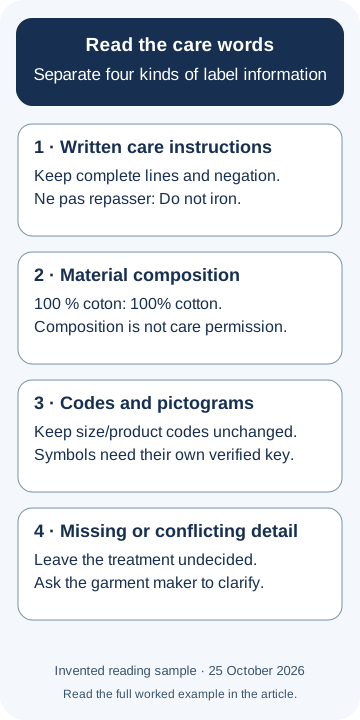
Translate the written care instructions as complete lines, then keep them beside the original label. Separate those instructions from fabric composition, size codes and pictograms. A material name such as cotton does not establish how the garment should be washed or ironed.
The completed French example below reads “Hand wash. Dry flat. Do not iron.” It shows which words carry the care instruction and which information must stay separate. You can finish this reading exercise without installing an app.
French → English · Illustrative workflow
Keep the complete care instruction
Invented language example, not captured app output or instructions for a real garment.
-
Read all three lines
French input
Lavage à la main. Séchage à plat. Ne pas repasser.
-
Read the illustrative meaning
English translation
Hand wash. Dry flat. Do not iron.
-
Separate material from care
100% cotton identifies composition. It does not cancel “Do not iron” or supply a missing washing temperature.
Read the written instruction before the material
This is an invented text-only label for explanation, not a real brand’s instruction for your clothing. The French wording and English meaning form a worked language example.
Keep all three instructions together. In particular, ne pas makes the final line a prohibition. A separate composition line is descriptive information, not permission to ignore that prohibition.
Example
- French care input
- Lavage à la main. Séchage à plat. Ne pas repasser.
- Illustrative English meaning
- Hand wash. Dry flat. Do not iron.
- Separate composition line
- 100 % coton: 100% cotton.
- Completed reading decision
- The three care instructions belong together. Cotton identifies a material; it does not cancel “Do not iron.”
- Unspecified information
- No washing temperature, detergent, stain treatment or other missing instruction is supplied by this example.
Sort the label into four kinds of information
Before translating, identify what each visible part is doing. Keep its position or a short description with your note so a material line is not mistaken for a treatment instruction.
- Written care instruction: translate the complete line, including a prohibition, condition, number or unit.
- Fabric composition: read the material and percentage as composition, then return to the separate care instructions.
- Size or product code: preserve the characters; translating surrounding words is not a size conversion.
- Pictogram: treat it as a symbol requiring its own verified interpretation, not as a foreign-language word.
Make one checkable reading note
A useful result retains what the original says and what remains unknown. Use the actual garment’s label for a real decision; do not copy the sample treatment onto another item.
- Keep the whole original label available and identify the garment in your note.
- Copy the complete written care lines without dropping a small negative word or a second line.
- Write the translated meaning beside each original line; keep numbers and units visible.
- Record material, size/code and pictograms separately rather than filling missing care instructions from them.
- If any instruction is unreadable or appears inconsistent with another part, mark it unresolved and ask the garment maker or a qualified cleaner before choosing a treatment.
Keep pictograms and fabric names separate
GINETEX’s care reference distinguishes washing, bleaching, drying, ironing and professional-care symbols. Its ironing guidance says to follow the care label rather than choose a temperature from fibre content. That is why the material line cannot replace a care instruction.
This guide does not identify a pictogram from your garment or reproduce a symbol chart. If the label contains only symbols, use the garment maker’s care information or an authoritative symbol reference. If you cannot establish the symbol’s meaning, leave the treatment undecided.
Example
- Known from the sample
- The material line says cotton.
- Not established by that fact
- A washing programme, an ironing temperature or permission to tumble dry.
- When words and symbols seem to disagree
- Keep both visible and ask the manufacturer to clarify; do not select whichever meaning seems easier.
Use translation for the next written line
After separating the label parts, written words are a language task. Translate Us lists photo and text translation, so its iPhone workspace is relevant when another care line is in a language you do not read. Keep the original beside any result and check the complete instruction before using it.
Photo translation and symbol interpretation are different claims. The listing does not establish that Translate Us recognizes laundry pictograms or can choose a treatment for a garment. The completed example above is a reading aid, not a promise of care success.
Worked label notes
Keep the care words with their original
The sample is an editorial translation exercise. It is not a captured garment label, app result or laundry recommendation.
Original care text: Lavage à la main. Séchage à plat. Ne pas repasser.
English meaning: Hand wash. Dry flat. Do not iron.
Separate material: 100 % coton = 100% cotton.
Decision: Composition does not cancel a care prohibition.
For a real item: identify the garment; keep original care lines, their meaning, material and symbols separate. Unknown or conflicting instruction: retain it as unresolved and ask the garment maker before choosing a treatment.
Quick check
Before you translate
- Keep the whole actual label available.
- Translate complete care lines.
- Preserve negation, numbers and units.
- Separate composition from treatment instructions.
- Check pictograms through an appropriate verified reference.
- Leave worn, missing or conflicting instructions unresolved.
FAQ
Frequently asked questions
Does 100% cotton tell me how to wash the item?
It identifies composition. Read the separate care instructions for the actual item; a material name does not supply a washing cycle or override an instruction such as do not iron.
Should I translate one word or the complete instruction?
Keep the complete line. Repasser concerns ironing in this example, while ne pas repasser prohibits it. Dropping the negative words changes the instruction.
What if the label contains only symbols?
Use the garment maker’s care information or an authoritative care-symbol reference. This written-language guide does not identify your symbol, and Translate Us symbol recognition has not been established here.
What should I do when part of the print is worn away?
Retain the visible original and mark the missing part as unknown. Ask the manufacturer or a qualified cleaner to resolve it before selecting a treatment; do not infer a temperature or method from the fabric name.
Can I use the sample instructions on my own shirt?
No. They are an invented language example. Use the actual garment’s instructions, including its symbols and any qualifications. Translation of a sentence is not verification that a treatment suits another garment.
Sources
Useful links
Take it with you
Read the written care line on your next label
Translate Us lists photo and text translation. For another label’s written words, check its iPhone listing and keep the original beside the result. Care symbols and unresolved treatment instructions still need their own check.
Explore Translate Us