Translate Us iPhone Translation Checks
Translate Singular or Plural You on iPhone: Who Is Invited?
Short answer: English you can address one person or several. Establish the intended audience from real context, make it explicit when known and ask the sender when it is not.
Clarify whether you addresses one person or a group before translating. Use complete one-person and two-person invitation examples without guessing the audience.

Published by Clara Publisher
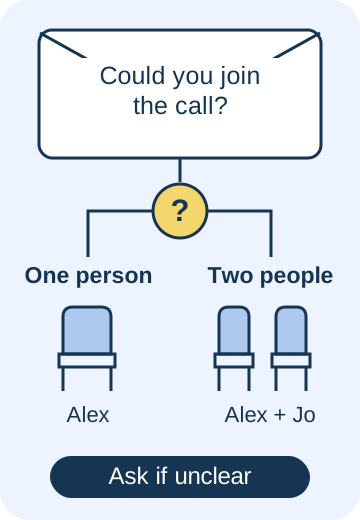
English you can mean one person or more than one. Before translating Could you join the call?, establish who is invited. The word alone does not tell you. A group chat also does not prove that every member is being addressed.
If only Alex is invited, a clear source is Alex, could you join the call? If Alex and Jo are both invited, use Alex and Jo, could you both join the call? These are different messages. Choose the one matching the sender’s actual intention; if that is unknown, ask before selecting a target form.
English → Spanish · Illustrative workflow
Both named people remain invited
Constructed editorial example, not captured app output, audience detection or a universal address form.
-
Known audience: Alex and Jo
English input
Alex and Jo, could you both join the call?
-
One illustrative polite Spanish request
Spanish translation
Alex y Jo, ¿podrían unirse a la llamada?
-
Check the intended audience
Alex and Jo are invited to join the call. This is the known two-person branch, not a way to decide an unknown audience.
Complete the invitation before translating
This constructed scenario concerns Alex and Jo. The first sentence does not establish whether one or both should attend. The completed alternatives below expose that choice instead of asking a translator to guess it.
Example
- Original English
- Could you join the call?
- Known one-person invitation
- Alex, could you join the call?
- Known two-person invitation
- Alex and Jo, could you both join the call?
- If the audience is unknown
- Is this invitation for Alex alone or for Alex and Jo?
- Illustrative Spanish for the known two-person invitation
- Alex y Jo, ¿podrían unirse a la llamada?
- Completed audience decision
- Alex and Jo are both invited in the two-person branch. The Spanish example uses one possible polite plural request. The one-person and unknown branches must not silently inherit that decision.
Find evidence of who the sender means
Read the sentence with the nearby conversation. A name, an explicit invitation list or the sender’s confirmation can identify the audience. The number of people in a chat, the number of people who read it and the number being invited are different facts.
For example, a message in a ten-person thread can ask Alex alone to join a call. A private message can ask Alex and Jo to attend together. Do not turn where a message appears into evidence about who it addresses.
If the wording names only Alex but the surrounding request seems to involve Jo, ask the sender. Do not add Jo merely because inviting both would seem convenient. Translation should preserve the intended invitation rather than expand it.
Use a four-step audience check
Keep the source intact while you work out the audience. A separate clarification is more useful than an unsupported singular or plural guess.
- Save the complete original sentence and read the nearby context for names or an explicit audience.
- State the known audience in a short note: Alex only; Alex and Jo; or not yet known. Do not infer it from chat membership.
- If it is known, prepare the matching complete source. Add the name for one person, or the known names and both for the two-person example. If unknown, send the clarification question instead.
- Translate the clarified message, then check that the target still invites the same people. If you cannot read its number or address form, ask a reader of that language to confirm the complete sentence before sending.
Keep audience count separate from tone
This check answers who is being addressed. It does not by itself decide how familiar, formal or polite the target wording should be. The relationship and the target language’s conventions still matter.
The group Spanish example is one possible polite invitation. It does not establish a universal plural formula or a form suitable for every region and relationship. Keep the known audience fixed while asking for wording appropriate to the actual recipients.
Do not append instructions such as use plural you to an ordinary message and assume a text translator will treat them as a setting. Your clarification note and the sentence intended for recipients have different jobs. Keep them separate.
Check the result against the actual invitation
For the two-person example, the completed check is: Alex is invited, Jo is invited, the action is joining the call, and no other participant has been added. Ask a target-language reader to confirm those points if the wording is unfamiliar.
Translate Us lists text translation on iPhone. A clarified invitation is a useful next text task: bring the complete sentence whose audience you already know, then compare the result with your audience note. This manual check does not require a promise that an app can infer the sender’s intention.
When the audience is unresolved, the useful next message is the clarification question. Do not let a polished translation turn unknown information into an apparent decision.
Audience note
Keep the intended recipients explicit
This is a completed editorial checking note. It is not a translator command or a special audience-selection control.
Original: Could you join the call?
Known audience: Alex and Jo
Prepared source: Alex and Jo, could you both join the call?
Check: both named people remain invited; no other person is added.
Quick check
Before you translate
- Identify the actual intended recipients.
- Keep unknown audience information unresolved.
- Use only the complete source matching the sender’s intention.
- Check the target audience separately from politeness.
FAQ
Frequently asked questions
Does you always mean everyone in a group chat?
No. A message can address one named person inside a group, or several people through one recipient. Use explicit context or the sender’s confirmation instead of counting chat members.
Can I add both to make the sentence clearer?
Only when two intended addressees are genuinely known. Alex and Jo, could you both join the call? is useful for that scenario, but adding both would change a one-person invitation.
What should I ask when the audience is unclear?
Name the real alternatives. For this example, ask: Is this invitation for Alex alone or for Alex and Jo? Wait for clarification before choosing between the one-person and two-person sources.
Does choosing plural also settle the polite form?
No. Audience count and the appropriate way to address those people are separate decisions. Preserve the known recipients, then check the complete wording against the target language, relationship and context.
What if I cannot recognise the target language’s singular or plural form?
Keep the clarified source and audience note. Ask a reader of the target language whether the complete result addresses exactly those people. A confident-looking output alone does not establish that.
Sources
Useful links
Take it with you
Translate the invitation after you know who it is for
Translate Us offers text translation on iPhone. Prepare the complete invitation for the known recipient or group, check the current listing, and use that clarified sentence for your next translation. Keep the audience note beside the result before sending.
Explore Translate Us