Translate Us iPhone Translation Checks
Translation Uses the Wrong Gender: What to Check on iPhone
Short answer: Check what the source actually says and what the person intends. Correct a known reference with language evidence; do not infer gender from a name, role or fluent output.
Separate a person reference from grammatical gender, correct one supported Spanish example and retain uncertainty when the source never supplied a gender.

Published by Clara Publisher
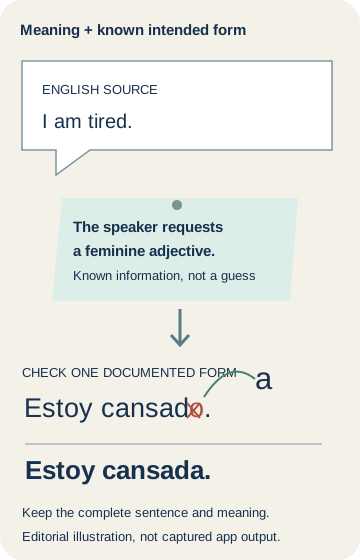
First identify what changed: an added he or she, a word describing the wrong person, or a grammatical ending. A translation is not evidence of someone’s gender. Use the intended reference supplied by the person, and leave missing information unresolved rather than guessing.
For a small completed example, take I am tired and a speaker who explicitly requests a feminine Spanish adjective. Estoy cansada is the corresponding wording. The source sentence alone does not supply that choice; the known intended form does.
English → Spanish · Illustrative workflow
Use the form the speaker actually requests
Constructed dictionary/grammar-backed example. Not captured app output, a gender setting or a guarantee for other languages.
-
Source plus known intended form
English input
I am tired. The speaker requests a feminine Spanish adjective.
-
Completed editorial Spanish wording
Spanish translation
Estoy cansada.
-
Check the whole sentence
The feminine adjective is cansada in this example. The English source alone does not specify it; do not infer a form from a name or occupation.
A completed correction with known information
Assume the speaker has told you to use the feminine Spanish form. You are checking a draft that says Estoy cansado. The dictionary lists cansada as the feminine form of the adjective meaning tired, and Spanish predicate agreement supports the correction to Estoy cansada.
This is an authored language example, not a captured translator result. It shows one adjective with a known intended form. It does not establish a universal rule that every ending in o can be changed to a, or that all languages express person reference in the same way.
Example
- English input
- I am tired.
- Known intended form
- The speaker explicitly requests a feminine Spanish adjective.
- Draft being checked
- Estoy cansado.
- Completed Spanish wording
- Estoy cansada.
- Meaning retained
- I am tired.
- Why this change is justified
- The requested form is known, and cansada is the documented feminine form for this adjective.
- Source and intended form
- I am tired. The speaker requests a feminine Spanish adjective.
Separate three different problems
A pronoun can add information that the original never stated. If a source identifies someone only as the doctor and a result supplies he or she, ask whether that reference came from genuine context. A familiar occupation or name is not that context.
Grammatical gender is a different category. Spanish persona is grammatically feminine even when it refers to a man. Agreement with that noun does not establish a real person’s identity. Check the exact word and construction before labelling an ending a person-reference error.
A known mismatch is different again: the intended person or requested form is explicit, but the target contradicts it. That can justify a correction, provided the target-language construction has been checked.
- Known reference: use the actual stated identity or requested wording, then verify the target construction.
- Unspecified reference: keep it unknown and ask for clarification or a fluent reader’s neutral rephrasing.
- Noun grammar: inspect the noun and agreement; do not read every feminine or masculine form as a claim about a person.
Make a correction you can explain
Keep the exact source and suspect target together. Mark the word that introduces or changes the reference. Write down the real information you have, including an explicit request for wording, before choosing a replacement.
If that information is missing, the useful result is an uncertainty note, not an invented answer. For example: Source only says the doctor. Gender is unspecified. Ask a reader of the target language to keep that information unspecified where the language permits it.
- Preserve the complete original and target sentence.
- Mark the changed pronoun, person word or agreement ending.
- Decide whether the source/context supplies the intended reference, or whether you only have a grammatical noun class.
- For a known correction, check the exact dictionary form and agreement, or ask a fluent reader to rewrite the full sentence.
- For unknown information, request clarification or a checked neutral construction; do not insert a guessed he or she.
- Read the complete revised target against the original, checking the action and meaning as well as the one changed word.
Avoid fixes that introduce a different error
Do not attach translator instructions such as make this feminine to a normal sentence unless you know how the tool treats them. A plain translation tool may translate the instruction as part of the message. Keep your editing note separate from the wording you intend to send.
Do not change every noun or adjective ending mechanically. Some forms do not change, and agreement can refer to a grammatically gendered noun rather than directly to the person. There is no single neutral construction that works unchanged in every language.
A translation service may show alternatives for some language pairs and input lengths. That does not establish a universal switch, and it does not establish such a feature in Translate Us. If you cannot inspect the relevant target wording, get a language check rather than treating a second fluent-looking result as proof.
Keep meaning and person reference together
Translate Us lists text translation and AI dictionary tools. Those can be relevant to your next short sentence and an unfamiliar word. The correction in this lesson comes from known intended wording and language evidence; it does not depend on a gender selector or a promise that installation fixes a wrong reference.
For your next message, preserve the intended meaning and the information that is genuinely known. Let the dictionary help with the word, and use a reader of the target language for the complete construction when it remains uncertain.
Keep a checking note
Keep the wording and the decision together
This is an editorial record template, not a special app command or an automatic audit feature.
Original: [unchanged sentence]
Target: [exact wording being checked]
Finding: [specific changed or unresolved detail]
Quick check
Before you translate
- Keep the complete original and exact target wording.
- Identify the specific changed detail.
- Use evidence for a correction; retain uncertainty when it is missing.
- Check the complete revised sentence before sending.
FAQ
Frequently asked questions
Can a translation tell me someone’s gender?
No. A generated pronoun or grammatical ending does not establish that fact. Use information actually supplied by the person or relevant context, without guessing from a name, occupation or voice.
Is a feminine Spanish noun always about a woman?
No. Persona has feminine grammatical gender and can refer to a person of any gender. Check noun agreement separately from a real person reference.
What if the original never says he or she?
Keep that fact unspecified. Ask for clarification or a fluent reader’s suitable neutral rephrasing instead of silently adding a pronoun. No one neutral expression works in every language.
Can I change cansado to cansada in every sentence?
No. The worked example has an explicitly requested feminine adjective referring to the speaker. Other constructions can have different agreement requirements; check the whole sentence.
Does Translate Us have a gender or pronoun selector?
That has not been verified here. The lesson uses known intended wording, dictionary information and sentence review rather than an app-specific control.
Sources
Useful links
Take it with you
Check the person reference in your next sentence
Translate Us lists text translation and AI dictionary tools. Keep your original beside the next short message, inspect unfamiliar words and verify who each reference describes before sending. Check the current iPhone listing for your needs.
Explore Translate Us