Translate Us iPhone Dictionary Guides
How to read a pronunciation guide on iPhone
Short answer: Use the notation key belonging to the entry you are reading. In Merriam-Webster’s bə-ˈna-nə, banana has three syllables, stress on the middle one and weak vowels at the ends.
Read the notation used by the dictionary in front of you. A completed banana example shows syllables, stress and weak vowels without an app installation.

Published by Clara Publisher
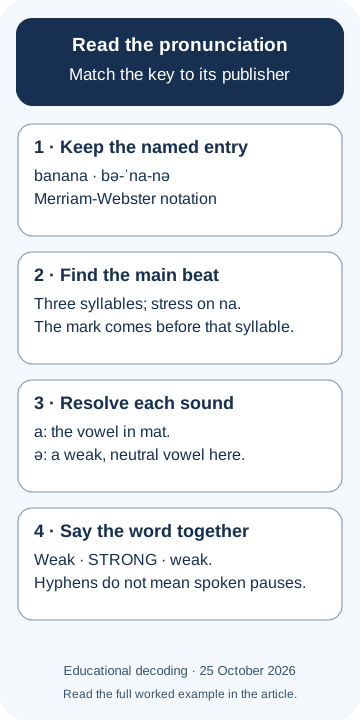
First identify which pronunciation system the entry uses. Read its sound symbols with that publisher’s key, then find the stress mark and syllable divisions. Do not pronounce the spelling as if it were the pronunciation guide.
Here is a complete small example you can use on an iPhone screen or on paper. Merriam-Webster lists banana as bə-ˈna-nə. In that entry, read three syllables with the strongest beat on the middle syllable. The first and last vowels are the weak sound called schwa.
English · Illustrative dictionary workflow
Read the pronunciation, not the spelling
Educational decoding of Merriam-Webster notation. Not Translate Us output, a recording or a speaking assessment.
-
Keep the named entry
English input
banana · bə-ˈna-nə
-
Decode the reading
Dictionary reading and meaning
Three syllables: weak bə · strongest na (a as in mat) · weak nə.
-
Keep the main beat
Put the strongest beat on the middle syllable and join the sounds without pauses.
Decode one complete entry: banana
Assume you already know banana means the fruit. The remaining task is how to read its sound guide. This example uses the first pronunciation shown in Merriam-Webster, not every accent variant.
Read bə, then the marked na, then nə as one word. The a in this publisher’s key has the vowel of mat; ə is a short, neutral vowel in the weak syllables. The capital letters in the plain-language cue below indicate emphasis, not a new spelling.
Example
- Known word
- banana
- Publisher notation
- bə-ˈna-nə
- Completed reading
- Three syllables: weak bə · strongest na (a as in mat) · weak nə.
- Stress cue
- ba-NA-na: give the middle syllable the main beat; do not insert pauses at the hyphens.
- Scope
- Decoding of a published dictionary entry, not captured app output or an assessment of your pronunciation.
- Displayed word and notation
- banana · bə-ˈna-nə
Match the key to the entry
A pronunciation key explains symbols; a definition explains meaning. Find the dictionary name and the key attached to its pronunciation system. A familiar-looking letter can represent a sound different from the one you expect from ordinary spelling.
The International Phonetic Association maintains the IPA chart. Other publishers can use their own respelling systems. Do not apply an IPA chart to a publisher-specific spelling guide merely because both contain ə.
- Keep the word and its definition together so you are checking the intended entry.
- Identify the publisher and any accent or regional label.
- Use that publisher’s examples for unfamiliar symbols.
- If the key is missing, keep the sound unresolved rather than invent a pronunciation.
Use the same reading order for your next word
Work from the displayed pronunciation rather than from a translation of the word. Mark what you have decoded before trying to say it.
- Keep the entry word, meaning and pronunciation notation visible together.
- Identify the notation system and open its own key or help text.
- Separate the syllables as the key directs and locate the primary stress mark.
- Resolve each unfamiliar sound using the key’s example word, then say the syllables together.
- Compare with the same entry’s recording when one is provided; keep a missing sound unresolved if you cannot check it.
Check stress, variant and meaning separately
The stress mark in the worked entry points to the syllable after it. A syllable separator helps you analyse the word; it does not instruct you to pause between pieces of a spoken word.
A regional variant is another labelled pronunciation, not a request to combine two transcriptions. Pick one labelled entry to study at a time. If the word has several meanings, confirm that the definition matches your sentence before using its pronunciation.
Example
- Mistake
- Reading the first ə as the full letter-name ay.
- Correction
- Use the key’s weak vowel for that position.
- Mistake to avoid
- Mixing the first listed transcription with a vowel from a separately labelled variant.
Keep a word’s meaning and pronunciation together
Once you can decode the entry, keep a short note containing the word, its meaning in your sentence, the publisher and the stress pattern. For the worked fruit word, that note can say: banana; three syllables; stress on the middle syllable.
Translate Us lists phonetics and AI dictionary tools for an iPhone word workspace. That makes it a relevant option when your next translated word needs both a meaning check and pronunciation information. The notation in this example belongs to Merriam-Webster; it does not establish which notation Translate Us displays.
Worked reading notes
Keep the key with the word
These are educational decoding notes. They are not a prompt feature, app output or a pronunciation score.
Word: banana.
Published notation: bə-ˈna-nə.
Decoded: three syllables; primary stress on na; weak ə at both ends.
For your next word: keep the entry, its intended meaning, publisher, notation and regional label together. Resolve one unfamiliar symbol with that publisher’s key before saying the word.
Quick check
Before you translate
- Confirm the word meaning in its sentence.
- Identify the pronunciation system and publisher.
- Find primary stress and syllable divisions.
- Use the correct key for unfamiliar sounds.
- Keep regional variants separate.
- Leave any unchecked sound unresolved.
FAQ
Frequently asked questions
Are pronunciation symbols the same as translated words?
No. A translation supplies wording in another language; a pronunciation guide represents sounds. A dictionary definition and the sentence establish which word meaning you intend.
Does every dictionary use IPA?
No. This worked example uses Merriam-Webster’s key. Use the key named by the dictionary you are reading instead of assuming that one chart decodes every publisher’s notation.
What does ə mean in this example?
It is schwa, a neutral vowel used here in the unstressed first and last syllables. Do not read it as the ordinary letter e or as the letter-name ay.
What if a recording sounds different from my first attempt?
Check the entry’s region label, stress and any unfamiliar vowel with the same publisher’s key. Follow one labelled variant at a time. A text example does not assess your actual speech.
Does Translate Us use this exact transcription?
That has not been verified. Its listing names phonetics and dictionary tools. This lesson decodes a named publisher’s entry and does not describe Translate Us controls, audio buttons or a scoring feature.
Sources
Useful links
Take it with you
Keep a word’s meaning and pronunciation together
Translate Us lists phonetics and AI dictionary tools. If you want an iPhone workspace for the next word you translate, check its current listing; use the notation key that matches the information you actually see.
Explore Translate Us